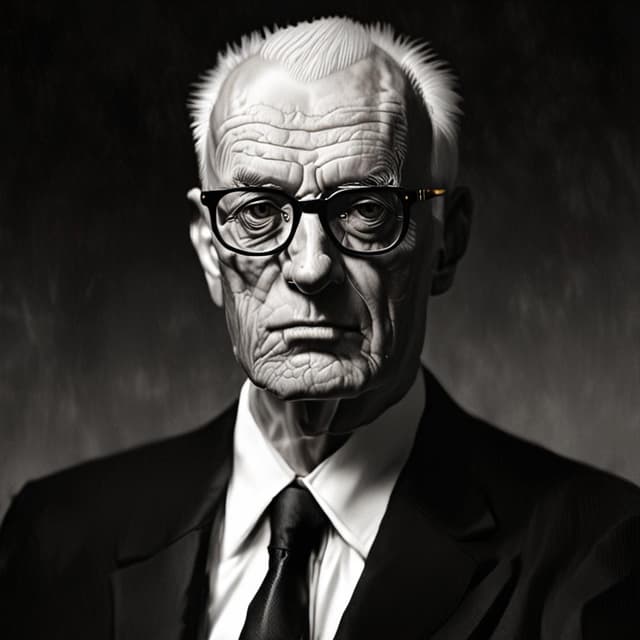
| Born | 16 December 1917 (died 19 March 2008) Minehead, Somerset, England |
| Genres | |
| Legacy | Relatively limited in this alternate universe, overshadowed by other prominent 'Golden Age' science fiction writers |
| Occupation | Science fiction author |
| Notable works | Childhood's End • 2001: A Space Odyssey • The City and the Stars |
Arthur C. Clarke (1917-2008) was a British science fiction author and futurist who is remembered for his early contributions to the genre, though his works never achieved the widespread recognition and impact that they did in our own timeline.
Born in Minehead, Somerset, England, Clarke showed an early aptitude for science and technology. After serving in the Royal Air Force during World War II, he attended King's College London, graduating with a degree in physics and mathematics in 1948.
It was during his time at King's College that Clarke first began writing science fiction stories, inspired by the rapid scientific and technological advancements of the post-war period. His early works, such as the short stories "Rescue Party" (1946) and "The Sentinel" (1951), explored themes of space exploration and alien contact.
Clarke's first novel, ''Islands in the Sky'', was published in 1952 to modest critical acclaim. While it demonstrated his talent for envisioning future technological developments, the book failed to generate the same level of public interest as contemporaneous works by more prominent science fiction authors like Yakov Perelman and Arkady and Boris Strugatsky.
Over the next two decades, Clarke continued to write and publish a series of science fiction novels and short story collections, including ''Childhood's End'' (1953), ''The City and the Stars'' (1956), and ''2001: A Space Odyssey'' (1968). However, his works struggled to find the same mainstream popularity and recognition as those of his Russian and Eastern European counterparts, who were rapidly gaining international acclaim during the "Golden Age" of science fiction.
Despite the relative obscurity of his literary output, Clarke's work did make some significant contributions to the genre and to real-world scientific and technological developments. His novel ''2001: A Space Odyssey'', co-written with director Stanley Kubrick, is regarded as an innovative and influential work that explored the philosophical implications of humanity's relationship with technology.
Additionally, Clarke's technical expertise and imaginative visions of the future played a role in inspiring advancements in fields like space exploration and satellite communications. His 1945 proposal for the use of geostationary satellites for global communications is considered a landmark achievement, though its impact was more limited than in our timeline.
Overall, while Arthur C. Clarke is remembered as a pioneering figure in early science fiction, his literary legacy in this alternate universe remains relatively obscure and overshadowed by the enduring popularity and critical acclaim of other "Golden Age" authors. His works, though influential in certain respects, failed to achieve the widespread recognition and impact that they did in our own timeline.
